
Fetal Development
Learn
- Human Development
- Abortion
- The Abortion Industry
- The Abortion Industry Overview
- Planned Parenthood Facts
- Planned Parenthood Racism
- Roe v. Wade
- Legal Analysis of Doe v. Bolton
- Women Killed by Legal Abortion
- Today’s Abortionists
- Why We Don’t Need Planned Parenthood
- A “Right” to Abortion?
- David Daleiden & the Undercover Videos
- Evidence of Planned Parenthood Targeting Minorities
- How to Defend Your Stance
- Consciousness
- Why Should You Care?
- The Basics: Talking About Abortion
- Abortion & Social Justice
- What About Rape?
- Life & Health of the Mother
- “My Body, My Choice”
- For Pro-Life Men
- Fetal Abnormality
- Right to Refuse
- Animal Rights
- Abortion and Overpopulation
- You’re Not Really “Pro-Life” If…
- Sample Questions & Answers
- Videos & Further Reading
- Miscarriage: Facts & Resources
- Birth Control
- Abortion Alternatives
- Other Life Issues
- Term Paper Topics
- Defund Abortion
The Milestones of Fetal Development
- Pregnancy starts at conception, when a man's sperm fertilizes a woman's egg.
- The sperm carries either an X or Y chromosome, which determines the gender of the baby. If the sperm carries an X chromosome, the baby will be female, and if it carries a Y chromosome, the baby will be male.
- The embryo then travels through the fallopian tube before implanting itself on the wall of the uterus.
- Once implanted, a neural tube forms that will ultimately become the baby's brain and spinal cord.
- Then, the circulatory system, including the umbilical cord, rapidly form.
- By Week 3, the baby's heart has begun to beat.
- The baby's hands, wrist joints, and limb nerves begin forming.
- At this point, all cranial nerves are present, and subtle movement begins.
- By Week 6, brainwav
 e activity has begun, and the baby's hands begin to move.
 - The baby's eyelids are growing. Arm and leg bones, tooth buds, and a primitive nasal cavity all begin forming.
- The baby's vital organs - kidneys, liver, pancreas, lungs, stomach, and intestines - start developing.

- The baby can turn its head, move its legs, and hiccup. Its hands can touch each other.
- The heart - which began beating weeks ago - is nearly completely developed, beating at a rate of between 165 and 170 beats per minute.
- The baby's feet develop tiny notches that will become toes, and knee joints form.
- The baby starts to grow hair around its eyebrows and in its mouth.
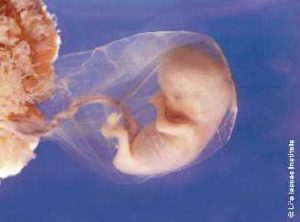
- Right/left-handedness emerges, and the baby begins to produce and release urine.
- At this point, the baby's joints are similar to those of an adult, and its fingers and toes are webbed but growing.
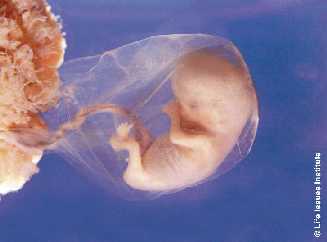
- In Week 9, the baby's weight increases 75%.
- The baby's head is much larger than the rest of the body, and it has developed early vocal cords.
- The baby can suck its thumb, move its tongue, and yawn.
- The baby begins to grow fingernails and toenails, and its bones start to solidify.
- At this point, the baby has its own unique fingerprints.
- Its eyes now roll down reflexively, and it forms buds that will eventually become secondary teeth.
- The baby's reproductive organs have formed, and its gender can now be seen via ultrasound.
- The baby's intestines absorb water and glucose, and its weight increases 60%.
- The baby's nose and lips have completely formed, and it begins making complex facial expressions.
- The baby forms taste buds, and its hands touch its mouth up to 50 times an hour.
- The baby's liver begins producing bile, and its bowel movements begin.
- Most of the baby's body is sensitive to touch.
- Cilia line the baby's airways, and teeth are growing.
- The baby turns away when its mouth is touched.
- The baby's cerebellum resembles that of an adult, and its cerebral cortex now has four lobes.
- Fat deposits present in the baby's cheeks.
- Stem cells arrive in bone marrow.
- Body fat emerges throughout body.
- Glucagon is present in the bloodstream.
- The mother can begin to feel the baby’s movements.
- Tooth enamel is forming.
- Bronchial tree is nearly complete.
- The baby has hormonal stress response to invasive procedures.
- The retina now has discrete layers.
- The cerebral cortex is now active.
- Meconium (made up of products of cell loss, digestive secretion, and swallowed amniotic fluid) is accumulating in the bowel.
- Eyes have now shifted to their final position, and ears are almost done moving.
- Melanin production begins.
- In female babies, the number of oogonia, which will become eggs, reaches its height; oogonia production ceases permanently.
- In male babies, the prostate gland begins to develop.
- Daily cycles in biological rhythms, such as sleep, begin.
- All skin layers and structures are now present.

- The cochlea in the inner ear reaches adult size and the baby can now respond to sounds.
- The eyelids separate and the eyes now open and close.
- The head is now about 20 centimeters in circumference.
- This is the earliest that low-levels of surfactat, a substance necessary for gas exchange in the lungs, are produced.
- Legs are reaching their correct proportions.
- The brain is growing very quickly; nerves begin making complex connections and will continue to do so until about 5 years after birth.
- Hair begins to grow on the scalp.
- A baby born prematurely at this stage has better than a 50% chance of survival.
- Cornea structure is now developed.
- White blood cells are developing to allow the baby to fight off infection.
- As the baby gains weight, the skin becomes less transparent and wrinkly.
- Hearing becomes clearer as inner ear bones harden.
- The brain weighs about 100 grams this week, and is about to start a major growth spurt, in which its size will increase 400-500%
- The baby’s nostrils open.
- Daily movement helps work out developing muscles.
- The baby can hear things outside the womb now, and will have a blink-startle response to a loud, sudden noise.
- Loud noises also cause an increase in heart rate and movement.
- Surfactant is now definitely present, so gas exchange outside the womb is possible.
- Rods and cones, which allow the eye to detect light and color, are now present.
- The baby now has the ability to taste, which affects the rate at which he or she swallows amniotic fluid. If the mother eats sweet food, he will swallow faster, while bitter food leads to slower swallowing.
- The intestinal lining now contains all adult cell types.
- The sense of smell is now present.
- Tear production now begins.
- Additional fat deposits continue to decrease wrinkles.
- Eyelashes are now growing.
- Pupils react to light.
- Fat deposits continue to build up so that the baby can maintain body temperature after birth.
- The placenta is maintaining a higher temperature than that of the rest of the mother’s body, roughly 100.7 to 102.5 degrees Fahrenheit.
- The baby can now differentiate between high and low frequency sounds from outside the womb.
- Bone marrow takes over the production of red blood cells from the liver.
- Smooth brain tissue is developing wrinkles and folds as brain mass increases.
- By now the baby can do somersaults by a series of movements similar to walking.
- The baby’s head is no longer disproportionate to the rest of the body.
- Eyes can move around in their sockets, and all the rest of the senses are functioning too.
- Movement becomes less pronounced as the uterus becomes more cramped.
- Breathing motions continue to be common, even though there isn’t any air in the womb.
- The cerebral cortex now consists of six layers.
- The head is now about 30 cm in circumference.
- The baby is most likely having dreams by this point.
- Growth will begin to slow down now, but weight at birth will still be approximately twice what it is now.
- A doctor will now begin noting the position of the baby in hopes that it will be born headfirst.
- The baby’s memory begins working, as he or she will typically prefer songs heard in the later part of pregnancy to ones heard only after birth.
- The formation of glomeruli, blood-filtering capillaries in the kidneys, is complete.
- Muscles of the lower esophagus are now functional.
- The baby’s skull bones have not fused and are very pliable.
- Amniotic fluid is at its highest level and will stay at this level until birth.
- The baby may settle into the head down position at this point, though it may happen later in pregnancy.
- The mother may gain additional weight at this point as the baby is doing the same.
- Rapid weight gain includes increase in brain weight as the myelin sheath around nerves is thickening during the last weeks of pregnancy.
- The immune system is continuing to mature so that the baby can fight infections.
- Pressure from the baby being head down may cause the mother to urinate more frequently.
- The baby has now developed a firm grip.
- He or she will now gain ½ to ¾ of pound each week.
- Lung development is almost complete and lungs are almost ready for birth.
- Surfactant production accelerates.
- Brain weight is approximately 300 grams.
- The immune system continues to develop as the baby receives antibodies from his or her mother.
- Fetus drinks an estimated 15 ounce of amniotic fluid each day.
- The baby is becoming more coordinated and can now grasp things.
- The pregnancy is now considered full-term and a doctor will not try to stop labor if it starts.
- Baby is considered “full term.”
- Breathing motions will sometimes cause the baby to get hiccups.
- Vernix, the waxy substance on the skin, is mostly gone now; only a small amount remains to help the baby go through the birth canal smoothly.
- The baby is gaining a half ounce to an ounce each day.
- The mother’s appetite may decrease as there is less room for everything in her body, including her stomach.
- The baby now has over 300 bones as the skeleton continues to develop.
- All organs are now ready for birth, including the lungs.
- The umbilical cord is now about 20 inches long and a half inch thick; due to crowding, it is not uncommon for it to get knotted.
- Baby is born!
- After birth, most of the vernix will be gone, though some traces may still be noticeable.
- The head may be cone-shaped after birth due to the passage through the birth canal, but will become round again in the next few days.
- The baby will be capable of crying at birth, though tears may not appear because of underdeveloped tear ducts.
Learn more
Many abortion advocates lack accurate information on fetal development. Medical research shows that preborn babies' hearts start beating at 21 days and that babies in the womb can feel pain as early as 12 weeks. For some, simply learning those facts is enough to change their minds on abortion. That's not true for everyone - but knowing these basic facts about fetal development can help you in your conversations with others.
Read More: Google Changed the Definition of “Fetus” But It Can’t Change Science
Websites:
- Just the Facts is an interactive website that shows visitors how babies develop in the womb through pictures and videos. The site also has teaching resources available.
- The Endowment for Human Development has detailed web and DVD resources that explain the development of the unborn in a scientific, yet accessible way.
Books:
Videos:
Sources: The Endowment for Human Development and BabyCenter.com.
